
Overgrown Trails Cleared and Passable in One Pass
Trail cutting in Evansville for properties where paths have closed in with brush, saplings, and years of unchecked growth
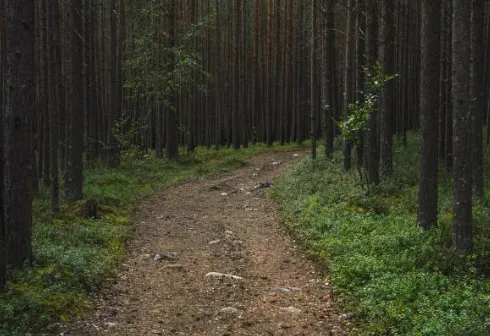
An established trail can become completely impassable within a few growing seasons when sapling encroachment and brush growth go unmanaged. Land Clear cuts and clears trails on rural and wooded properties throughout Evansville and the surrounding area using forestry mulching equipment—the mulching head moves along the trail corridor, chips saplings and brush on contact, and leaves wood chips in place that decompose and improve the ground rather than leaving a stripped, bare path. The trail emerges cleared and walkable after a single operation, with no debris hauling required.
The crew brings the mulching machine to your property, confirms the trail path with you, and operates the head along the corridor you specify. Because the machine processes brush and saplings simultaneously rather than requiring them to be hand-cut first, the operation moves efficiently even through corridors that have not been maintained in years. The chip layer left on the trail surface helps stabilize the path and prevents the bare-soil erosion common on trails cleared by stripping or scraping.
Call Land Clear at (812) 562-5263 to describe your trail conditions and get a free estimate for the clearing operation.
What Trail Clearing Actually Accomplishes Versus Simple Brush Cutting
Simple brush cutting removes the visible vegetation but leaves stumps, root crowns, and cut material that has to be managed separately. Over time, those stumps re-sprout and the trail closes back in faster than it did originally because the root system is still intact and actively sending up new growth. Forestry mulching processes the stem and surface material to chips, reducing the re-sprouting cycle and leaving the trail corridor in better long-term condition. For properties in areas like Vincennes and Oakland City, where wooded rural acreage with overgrown access paths is common, this distinction between cutting and mulching affects how often the trail needs attention going forward.
After Land Clear finishes a trail cutting operation, the path is immediately accessible for foot traffic, ATV use, or equipment access depending on the width cleared. The chip layer on the trail surface compacts slightly underfoot and provides better traction than bare dirt, particularly on sloped sections where erosion would otherwise begin quickly after clearing. No secondary cleanup, debris removal, or stump grinding is needed because the mulching head handles all of it in one pass.
Land Clear is a family-owned, insured operation with over a decade of this work, five-star Google reviews, and free estimates for properties within a 60-mile radius of Evansville. Trail width, length, and vegetation density all factor into how the crew sequences the operation, and the estimate process is designed to account for those specifics before any work begins..
What Property Owners Ask About Trail Cutting Work
The following questions cover how trail cutting with forestry mulching equipment works, what the crew handles during the operation, and what the trail looks like once the work is finished.
How wide a trail corridor can the forestry mulching machine clear in one pass?
The mulching head width determines the effective cut width per pass, typically in the range of five to eight feet depending on the machine configuration. For wider trail corridors, the operator makes parallel passes with overlap at the edges to achieve the target width you specify.
What happens to the trail surface after the chips are deposited?
Chips settle on the trail surface within the first few weeks of foot or vehicle traffic and gradually decompose over months. The decomposed material integrates into the soil, which improves the surface layer over time. Unlike bare-soil paths, the chip-covered surface holds up better during periods of heavy use.
How does the crew handle turns, narrow sections, and areas where the trail changes direction?
The operator controls the machine at low speed through turns and adjusts the head angle at transitions. Tight turns on narrow trails may require a multi-point repositioning, but the compact machine size allows it to navigate most trail layouts found on rural wooded properties in this region without needing a separate access cut.
What type of vegetation is too large for the mulching head to process along a trail corridor?
Mature trees with trunk diameters beyond the mulching head's capacity—typically well above what would be found in a trail corridor that has closed in through sapling regrowth—are outside the scope of the machine. The crew identifies any such obstacles during the estimate visit and discusses how to address them before the operation begins.
How should a property owner prepare the trail route before the crew arrives?
Walk the intended path and mark any features you want to preserve—specific trees, fence lines, utility lines, or boundary markers. The operator follows the corridor you indicate, so a clear understanding of the route before the crew arrives produces a more accurate result than routing on the fly.
Land Clear also cuts and clears trails in Henderson, Owensboro, Princeton, Mount Vernon, and Newburgh. To move forward with a free estimate, contact Land Clear at (812) 562-5263 and share the length and current condition of the trail you need cleared.