
Invasive Brush Cut Down Without Leaving a Mess
Invasive growth removal in Evansville for properties overtaken by vines, brush, and unwanted woody species
Thick stands of invasive brush and vines do not respond well to mowing or manual cutting—they resprout from the root crown and reclaim ground within a season. What changes the outcome is removing the above-ground mass efficiently so that the site can be managed going forward, whether by follow-up treatment, grazing, or replanting with intended species. Land Clear handles this work in Evansville using a forestry mulching machine that chips invasive growth in a single pass, leaving the material on site as wood chips rather than piling it or burning it. The result is a cleared surface without the logistics of a separate debris removal operation.
Properties across this region develop dense concentrations of invasive saplings, vines, and opportunistic brush on fence lines, lot edges, field margins, and reclaimed parcels. The forestry mulching head is sized to process this material—saplings, tangled vines, and multi-stemmed shrubs—without requiring chainsaw pre-cutting or hand clearing ahead of the machine. The crew clears to the depth and boundary you specify, working across the affected area in a pattern that processes the overgrown zone systematically rather than selectively.
Contact Land Clear to walk the affected area and define the clearing scope before scheduling equipment.
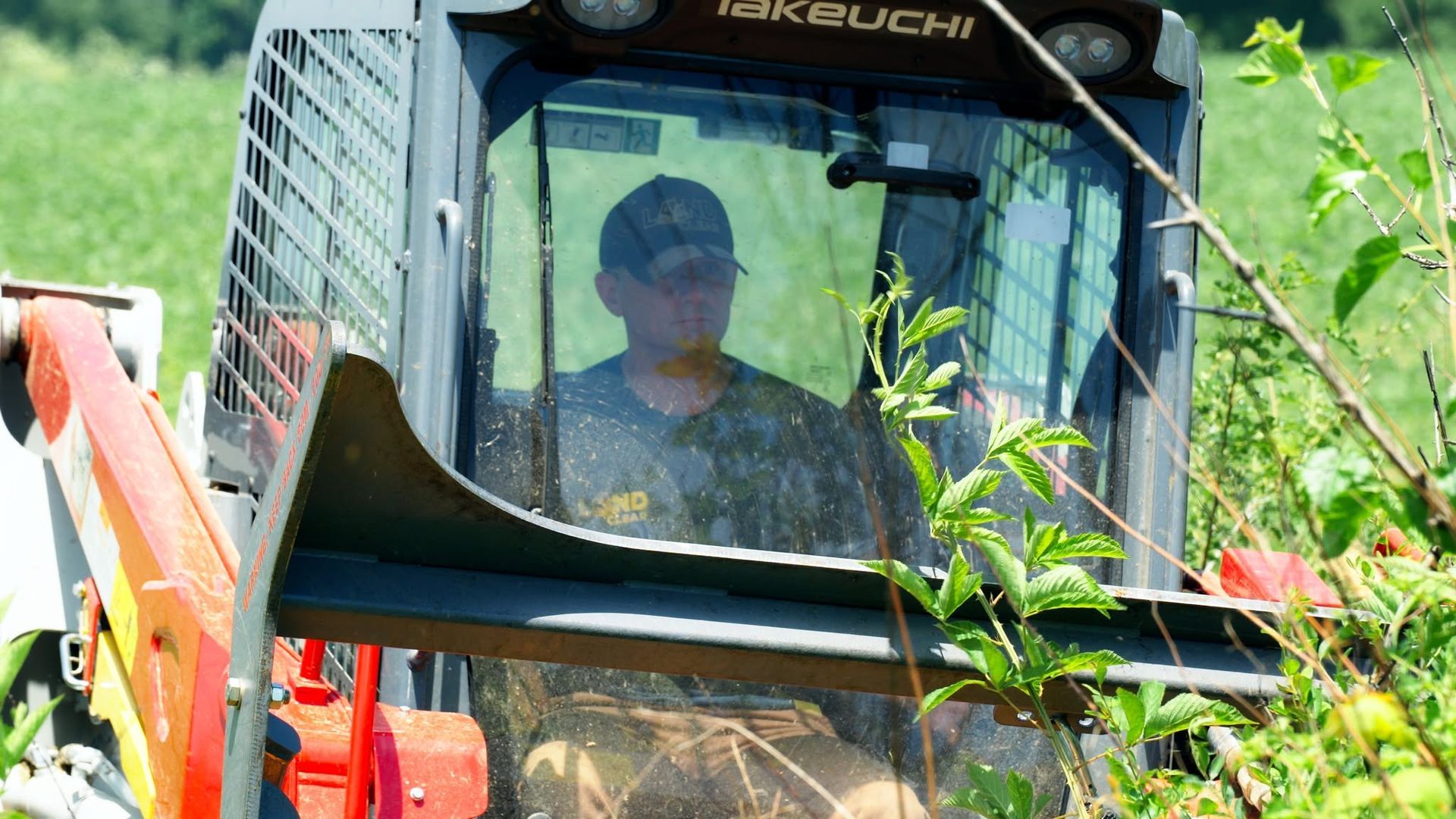
Why Forestry Mulching Works for Invasive Species
The mulching head processes standing vegetation by engaging it at the base and chipping it fine enough that the material stays on site as ground cover rather than requiring removal. For invasive growth specifically, this matters because the alternative—cut-and-pile clearing—produces large volumes of brush that must be burned or hauled, which adds cost and time without adding anything to the soil. The chipped material from a mulching pass decomposes and feeds the ground rather than leaving bare, compacted soil that invasive species recolonize faster than intended plants can establish.
After Land Clear completes a clearing pass, the most noticeable change is the return of usable ground. Areas that were impenetrable become open. The mulch layer across the cleared zone is uniform and flat rather than the uneven, debris-covered surface that follows manual clearing. For properties where the invasive growth had been spreading into productive areas, the cleared boundary becomes visible and manageable again. The operation produces no burn pile residue, no tire ruts from haul trucks, and no charred soil surface.
Invasive growth removal through forestry mulching addresses the above-ground mass of saplings, brush, and vines. Species that spread primarily through root systems—like some varieties of native sumac or aggressive vine root structures—may resprout from below grade after the above-ground growth is removed, and follow-up management decisions depend on the specific species involved and the intended land use after clearing. Discussing the plant types present on site before work begins helps set accurate expectations for what a single clearing pass will accomplish.
Common Questions About Invasive Growth Removal
These questions address how the removal process works and what to expect once the overgrown area is cleared.
How does forestry mulching handle tangled vines mixed with saplings?
The mulching rotor engages the combined mass of vines and woody stems together, processing both in the same pass without requiring them to be separated or pre-cut by hand.
What does the cleared surface look like after the machine finishes?
The area shows a layer of wood chips distributed across the ground, with all standing vegetation removed to grade level and no piles, windrows, or burn areas remaining.
Why do some invasive species reappear after clearing and what affects that?
Species that store energy in deep root systems can generate new top growth from the crown even after the above-ground material is fully removed, which is why understanding the specific species present helps determine whether a single pass is sufficient or whether follow-up will be needed.
How is the clearing boundary established on properties with irregular edges?
The crew confirms the clearing area with you before starting, using site-visible markers or natural boundaries like fence lines and tree rows to define where the machine operates and where surrounding vegetation remains.
How does invasive growth removal on older Evansville-area parcels differ from newer properties?
Parcels that have been unmanaged for more than five to ten years often have invasive species established at multiple growth stages simultaneously—ground-level seedlings, mid-canopy saplings, and mature multi-stemmed specimens—which affects how many passes the machine needs to work through the full density of the stand.
Land Clear also removes invasive growth in Henderson, Owensboro, Princeton, Mount Vernon, and Newburgh. Reach Land Clear at (812) 562-5263 to describe what is growing on your property and get a free estimate based on current site conditions.