
Brush Cut Down and Chipped Without Leaving Debris
Brush removal in Evansville for properties where dense vegetation has blocked access, reduced usable acreage, or overtaken cleared areas
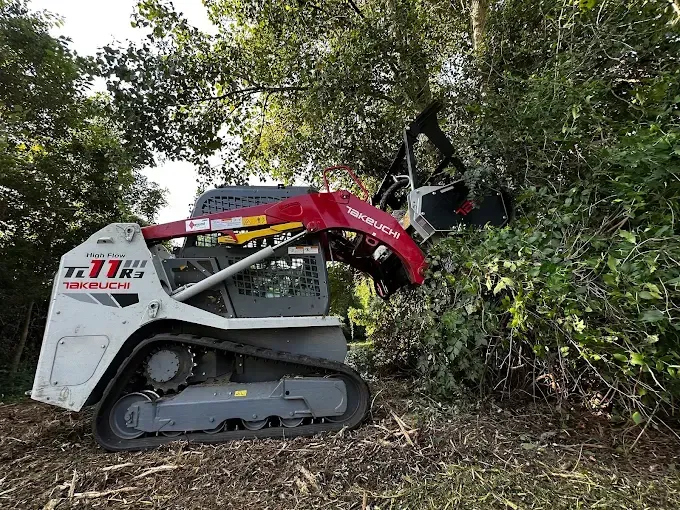
Brush encroachment does not happen all at once—it builds over seasons until a property that was once manageable becomes impassable. Land Clear addresses this through forestry mulching: the crew brings equipment to your Evansville-area property and operates the mulching head directly through the brush, chipping all vegetation on site rather than cutting it and hauling it away. The result is a cleared surface covered in wood chips that decompose and improve the soil, not bare ground stripped of organic material.
The mulching head handles the full range of brush types in one systematic pass—small saplings, woody stems, thick thickets—without requiring hand cutting as a preliminary step. Because the machine chips material in the same motion it contacts it, there is no intermediate stage where cut brush needs to be gathered, stacked, or removed. The crew manages the full operation from setup through completion, and nothing is left on site that requires follow-up management.
Schedule an on-site visit so Land Clear can assess your brush conditions and define the scope of the removal operation.
Why Mulching Outperforms Cutting and Hauling for Brush
Hand cutting or mechanical brush cutting leaves material on the ground that has to be dealt with separately—either burned, chipped by a separate machine, or hauled off in loads. Each of those steps adds cost and time, and burning leaves compacted, nutrient-depleted soil. Forestry mulching eliminates the intermediate steps because the same machine that contacts the brush also chips it and deposits it as usable material. For dense brush situations, particularly the invasive sapling and thicket combinations common throughout the Evansville area, that single-pass efficiency is the primary reason mulching costs less and takes less time than conventional brush removal.
After Land Clear finishes a brush removal, the treated area is immediately accessible. The wood chip layer left behind is not a nuisance—it suppresses weed regrowth in the short term and feeds soil biology as it breaks down over months. Property owners working to reclaim land around Owensboro-area parcels notice this difference compared to sites where brush was burned or mechanically scraped: the mulched surface retains its topsoil structure rather than starting from bare, compacted ground.
Land Clear uses Zappy QR cards at job completion so clients can easily leave reviews, and the company responds to every review within 24 hours. That practice reflects an operational standard—not a marketing gesture—and is consistent with how the crew handles communication throughout the project..
Common Questions About Brush Removal Work
The following questions address how brush removal using forestry mulching works in practice, what the crew handles on site, and what property owners should expect when the work is finished.
How does the mulching machine move through thick brush without getting stuck or requiring pre-clearing?
The mulching head is mounted on a compact, tracked or wheeled machine designed to push through dense vegetation. The head contacts brush at the leading edge and chips it immediately, so the machine clears its own path as it advances through the designated area.
What brush sizes and types can the forestry mulching equipment handle?
The equipment Land Clear operates processes small saplings, woody shrubs, and dense thickets in one pass. Material with stems in the range typical of invasive brush species—the growth pattern most common on idle Evansville-area parcels—is within the operating range of the mulching head without modification.
When does brush removal require more than one pass through an area?
Very dense stands where vegetation has grown into tangled overhead canopy may require a second pass to ensure all stems are chipped to ground level. The crew evaluates this on site and adjusts the operation accordingly rather than committing to a fixed pass count before seeing the conditions.
What is left on the ground after the brush removal is complete?
A layer of wood chips covers the cleared surface. There are no unprocessed stems, no cut piles, and no debris requiring removal. The chip layer is typically one to three inches deep depending on brush density and settles further as decomposition begins.
How does the crew handle the boundary between the area being cleared and adjacent vegetation that should stay?
The operator controls the mulching head at the boundary line precisely, following the perimeter you designate. Edges are managed by controlling the sweep of the head rather than by installing physical barriers, so clear communication about the boundary before work starts is the most important preparation step.
Land Clear also performs brush removal in Henderson, Owensboro, Princeton, Mount Vernon, and Newburgh. To get a free estimate for your property, call Land Clear at (812) 562-5263 and describe the brush conditions on your site.